WORKFLOW FOR TEAMS
Faxing for legal correspondence
Route faxing for legal correspondence to the right people, then check delivery and follow-up in one account.
- Typical sender
- Legal team
- Receiving party
- Court, counsel, or client
- Review owner
- Matter owner
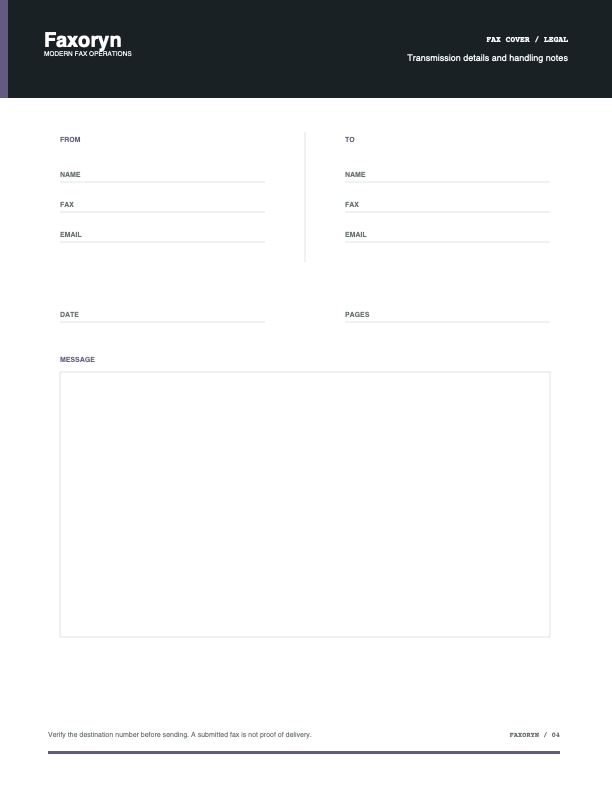 SAMPLE DATA
Matter correspondence
- Primary risk
- Deadline, approved version, and confidential handling
- Completion evidence
- Matter reference, exact destination, and final state
TYPICAL WORK
Start with the record, not the sector label.
HOW THE WORK FLOWS
Give the document a responsible path.
- SENDERLegal team
Prepares the approved document and complete destination.
- RECIPIENTCourt, counsel, or client
Receives the fax through the intended route.
- OWNERMatter owner
Reviews the result and owns the next action or the follow-up when something fails.
- EVIDENCEMatter reference, exact destination, and final state
Closes the task without treating the send itself as delivery.
WHAT TO CHECK
The page describes an example workflow, not regulatory approval.
WHAT TO CHECKHOW TO CONFIRM IT
Deadline, approved version, and confidential handlingMatter reference, exact destination, and final state
Fit for your live use and obligationsCurrent contracts, settings, policy, and legal review
OPERATING CONTEXT
Where fax enters legal work
Legal teams often exchange matter correspondence, signed forms, notices, discovery records, and client documentation. Each document must be identified, assigned, reviewed, and retained before the next business step can happen.
Faxoryn keeps the destination, document, owner, timestamps, and delivery outcome together so the team can see what happened without relying on a machine tray or forwarded email thread.
This page covers legal. Check the relevant account setting or fax record before you continue.
- Route incoming work to a clear owner or shared operating list.
- Keep a reviewable record of outgoing documents and their final state.
- Use contacts, labels, and number assignments consistently across the team.
SYSTEM CONNECTIONS
Connect fax to the tools used by legal teams
A practical implementation may connect matter systems, document repositories, assigned numbers, and email notifications. The connection should reduce repeated entry while preserving destination review and a single final delivery state.
Test permissions, supported documents, notifications, expired authorization, and carrier downtime before relying on a connected path for time-sensitive work.
CONTROL POINTS
Design the legal workflow around responsibility
Decide who can access each number, who follows up on a failed or unread fax, and how long documents and delivery records must remain available.
Regulatory obligations depend on the organization, region, data, vendors, and configuration. A cloud fax product does not make a workflow compliant by itself.
- 01List active fax numbers, document types, and recipient groups.
- 02Assign each intake and sending workflow to an accountable team.
- 03Define notification, exception, escalation, and retention rules.
- 04Send sample documents end to end before replacing an established route.
MEASUREMENT
Review exceptions, not only successful volume
For legal operations, review matter identification, recipient authorization, filing deadlines, privilege, and retention. Failed delivery, unread intake, duplicate handling, and unclear ownership often create more risk than ordinary successful faxes.
INBOUND PLAYBOOK
Turn incoming legal documents into assigned work
Receiving matter correspondence, signed forms, notices, discovery records, and client documentation is only the start of the process. Match the document to the correct person, case, account, property, claim, order, or program before it enters downstream work.
Assign each active fax number and notification path to a named owner or governed work list. Define how unread items are escalated, how an incorrect destination is handled, and how sensitive attachments move into the approved record system.
- 01Receive the document on an active assigned number.
- 02Verify its identity, expected pages, and intended workflow.
- 03Assign the next action without forwarding uncontrolled copies.
- 04Retain the fax state and business-system reference for follow-up.
OUTBOUND PLAYBOOK
Make outgoing legal delivery reviewable
Before sending matter correspondence, signed forms, notices, discovery records, and client documentation, confirm the approved version, complete destination, page order, cover context, and person authorized to release it. Use saved contacts or groups only after the final destination remains visible to the operator.
Treat accepted, sending, delivered, and failed as different states. Keep the source business reference with the Faxoryn record number, and define when a failure may be retried, when the recipient must be contacted, and when an incident requires escalation.
ROLL-OUT CHECK
Prove the legal workflow with real operating cases
Send common documents and the difficult cases named for this sector: matter identification, recipient authorization, filing deadlines, privilege, and retention. Try both ordinary delivery and the conditions that require a person to intervene.
Approve number ownership, member access, notification destinations, connected-system permissions, retention, support, monitoring, and rollback before replacing an established fax route.
COMMON QUESTIONS
Details to check before you continue.
Does this page certify Faxoryn for my industry?
No. This page describes how teams in your industry typically use fax. Compliance depends on your jurisdiction, contracts, and how your team actually works.
What should I do before relying on this workflow?
Send one sample document from start to finish, decide who follows up, and check the final delivered or failed state before making it part of your regular process.
Where do I confirm the result?
Check the Faxoryn record: destination, timestamps, final state, and the person responsible for the next step.
Who should own the follow-up after a send?
Assign one person to check the final delivered or failed state and to own the next step when a document does not arrive as expected.
TALK THROUGH THE WORKFLOW
Find the right starting point for your team.
Share only the context needed for a useful first conversation. You can start with a browser workspace without waiting for a sales call.
- Use case and expected monthly volume
- Team size and destination country
- Preferred follow-up channel